Yoga & Yoga Therapy for every treatment of Cancer

A summary of Evi’s Dimitriadou presentation the British Society of Integrative Oncology on the role of Yoga Therapy to Cancer Patients and survivors.
Cancer and Cancer treatment-related side effects
Cancer patients and survivors not only experience the disease, but they also suffer
from cancer treatments’ side effects that may last for years after the completion of
the treatments. Finding effective ways to manage cancer treatment-related side
effects is among the highest clinical research priorities at the National Cancer
Institute and Yoga seems to be able to support this goal (Lihn et al., 2018).
Yoga and Yoga Therapy
Yoga is ancient mind and body intervention, that promotes and maintains physical
and mental wellness through the use of postures, breathing techniques and guided
relaxation or meditation.
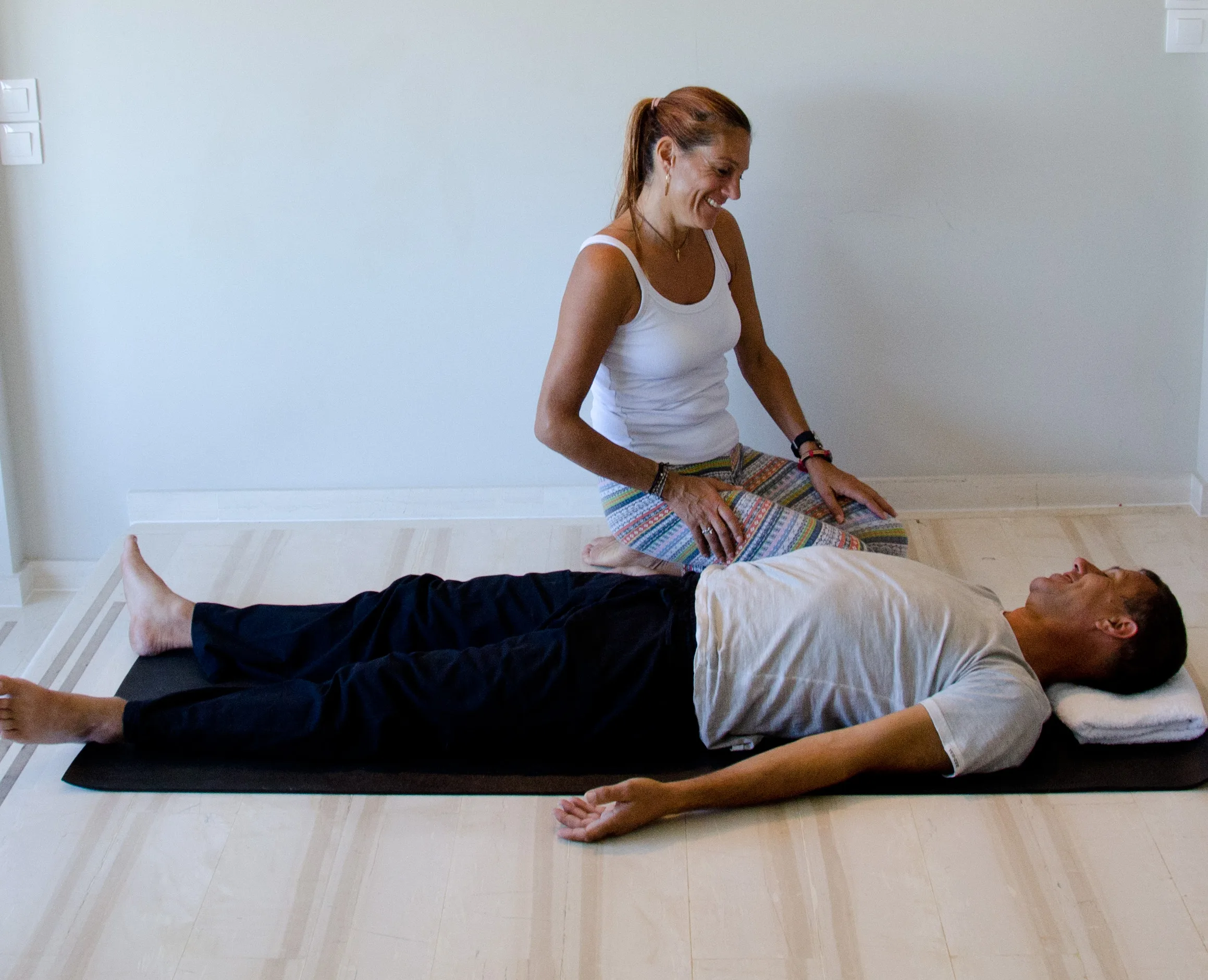
Yoga Therapy, the person-centred, personalized application of yoga takes into
account the bio-energetic-psycho-socio-spiritual condition of the individual and is
given as prevention, therapy and palliative care in 1-2-1 basis and in specific groups
by Yoga Therapists who quite often they are also Health Professionals such as
Psychologists, Physiotherapists, Nurses or Doctors. Yoga Therapy is the clinical
application of the principles and practices of yoga promoting health and well-being
within a therapeutic relationship that includes personalized assessment, goal setting,
lifestyle management, and yoga practices for individuals or small groups, according
to the International Association of Yoga Therapists (IAYT, 2020).
Both Yoga and Yoga Therapy work in alignment with BSIO major goals of enhancing
better quality of life, improving resilience, supporting individuals for better treatment
tolerance and offering better management of the treatment’s side effects.
The needs and the yoga tools of each step of the Cancer Challenge
Both Yoga and Yoga Therapy can address the different needs that cancer patients
experience during the different treatments. Knowing the needs of each step of the
Cancer challenge, the common side effects of each treatment but also how each
yoga tool works for these specific needs is imperative for a safe and efficient
integration of yoga.
The diagnosis brings high levels of anxiety and even identity crisis, while it also
affects the breathing pattern.
Breath awareness, breathing practices that enhance slow breathing (Russo et al.,
2017), and guided relaxation (Hadjibalassi et al., 2018) have positive effects on the
sympathetic nervous system, on the hypothalamic pituitary adrenal (HPA) axis and
on stress reduction.
The operation causes pain, stiffness, fibrosis and occasionally in breast cancer
lymphedema.
Before and after the operation, guided meditation/body scan/yoga nidra enhances
relaxation, lowers the anxiety levels and the pain perception in combination with mild
movements as it was seen in breast cancer (Kovacik and Kovacik, 2011).
The chemotherapy, the radiotherapy and the hormonal therapy are highly related
with nausea, peripheral neuropathies, musculoskeletal pains and aches,
cardiotoxicity seen as reduced cardiorespiratory fitness and tendency for
hyperventilation, brain fog due to diminished neurogenesis (Dias et al., 2014),
artificial menopause symptoms such as hot flashes, insomnia, fatigue, depression
and anxiety while in the long-term osteopenia and osteoporosis is a strong
possibility.
Yoga is seen efficient for cancer patients and survivors in managing chemotherapyinduced peripheral neuropathy and fall risk (Bao et al., 2020), in musculoskeletal
pain (Peppone et al, 2015), in cardiotoxicity (Kang et al., 2021), in brain fog and
cognitive impairment (Janelsins et al., 2016), in hot flashes (Cramer et al., 2015), in
treating insomnia (Mustian, 2013), in fatigue (Linh et al., 2019), in anxiety and
depression (Gonzalez et al., 2021) and in osteoporosis (Lu et al., 2016).
Last but not least, Yoga’s effectiveness is seen in reducing the biomarkers
measuring the inflammation in people with chronic conditions (Djalilova et al., 2018),
and in breast cancer survivors (Kiecolt-Glaser et al., 2014).
Despite the so many side effects, most of them are manageable and even reversible
with the appropriate lifestyle choices such as being physical active and manage
stress levels, goals that are fully supported by yoga and yoga therapy.
The Author
Evi Dimitriadou, is a C-IAYT Yoga Therapist, Yoga Therapy Educator and founder of
Yoga Therapy Greece which gives international IAYT Accredited Yoga Therapy
Trainings. She is also a Physiotherapist and is currently doing a master’s degree in
Psychology and Neuroscience at King’s College, London.
For more information, please visit her website https://yogatherapygreece.com/