NCIO 2026 Conference – Personalised Yoga for Cancer Pain & Symptoms

Yoga Therapy – Personalised Yoga for Cancer Pain & Symptoms
By Evi Dimitriadou
C-IAYT Yoga Therapist, Registered Physiotherapist in the UK,
PG in Neuroscience & Psychology at King’s College, London.
Founder of Yoga Therapy Greece Clinic and School & Yoga Therapy Educator.
This is a short presentation at the NCIO in Oxford University on 19th of September 2026 about pain and related symptoms in cancer patients. It reviews what pain is in cancer patients and the recommendations of the SIO-ASCO guidelines for pain and related symptoms in relation to yoga tools, it explains the difference between yoga and yoga therapy, how yoga therapy works and how it can benefit the cancer patients.
Pain in Cancer Patients
Pain can be tumor burden, treatment-related, or non–cancer-related; neuropathic due to chemotherapy-induced peripheral neuropathy (CIPN) or musculoskeletal due to treatments with aromatase inhibitors (AI) and can be acute or chronic.
Pain is perceived through the sensory nerves; it affects the nervous system by activating the sympathetic branch of the nervous system, as stress does, and is modulated by the state we are in (of the nervous system), by what we do as well as by what we think (particularly) about the pain.
Pain not only causes physiological changes by activating the stress response, but also changes in body awareness, posture, and movement; behaviours such as fear of movement, poor sleep, isolation, changes in facial expressions and body language; and mental wellbeing.
SIO-ASCO Guidelines
The guidelines by the Society for Integrative Oncology (SIO) and the American Society of Clinical Oncology (ASCO) for Pain in patients with cancer recommend that yoga may be offered for aromatase inhibitor-related joint pain, while for general pain or musculoskeletal pain, hatha yoga and guided imagery may be offered (Mao et al., 2022).
In addition, the guidelines for Anxiety in patients with cancer recommend (Carlson et al., 2023):
- Mindfulness-based interventions (MBIs) during treatment and post-treatment
- Yoga during treatment and post-treatment
- Relaxation therapies during treatment.
The guidelines for Depression in patients with cancer recommend (Carlson et al., 2023):
- Mindfulness-based interventions (MBIs) during treatment and post-treatment
- Yoga during treatment and post-treatment
- Relaxation therapies during treatment
The guidelines for Fatigue in patients with cancer recommend (Bower et al., 2024):
- Exercise during treatment and post-treatment
- Mindfulness-based interventions (MBIs) during treatment and post-treatment
- Yoga post-treatment
Although yoga and yoga tools such as guided relaxation, as well as mindfulness tools such as yoga, breathing, and meditation, are recommended, they are not strongly recommended since yoga practices are not standardized and yoga therapy, tailoring yoga to each patient, is challenging in the protocolized research context.
Yoga therapists see every day the benefits that cancer patients experience after yoga therapy sessions, something that research has not depicted yet.
Yoga and Yoga Therapy
Yoga is an ancient mind-and-body practice that promotes and maintains physical and mental wellness through movements, breathing techniques, guided relaxation, and meditation.
Yoga movements and restorative postures enhance interoception, proprioception, and coordination; release tension, establish range of motion, realign the posture, and strengthen muscles and bones.
Breathing exercises focus the mind, enhance slow breathing, and balance the autonomic nervous system.
Meditation, by focusing attention on a particular object, thought, or activity, achieves mental clarity and relaxation.
Yoga Therapy is a person-centred and personalised approach to yoga that considers the bio-energetic, psycho-socio-spiritual factors of the individual.
Yoga Therapy is the clinical application of yoga principles and practices, promoting health and well-being within a therapeutic relationship that includes personalized assessment, goal setting, lifestyle management, and yoga practices for individuals or small groups (IAYT, 2020).
In Yoga Therapy, we meet individuals where they are and accompany them where they want to go, addressing their needs in a personalized way.
Yoga Therapy is given by Yoga Therapists, who areadvanced yoga teachers who have learned through yoga therapy training to conduct intakes, breathing, postural, and movement assessments, know the symptoms of mental and physical ailments, and how to modify and adapt yoga tools to the individual’s needs.
Certified by the International Association of Yoga Therapists (C-IAYT), Yoga Therapists complete at least 2 years of yoga therapy training of very high standards. Yoga Therapistsare often also health professionals, sharing a whole-person approach in a more evidence-informed way.
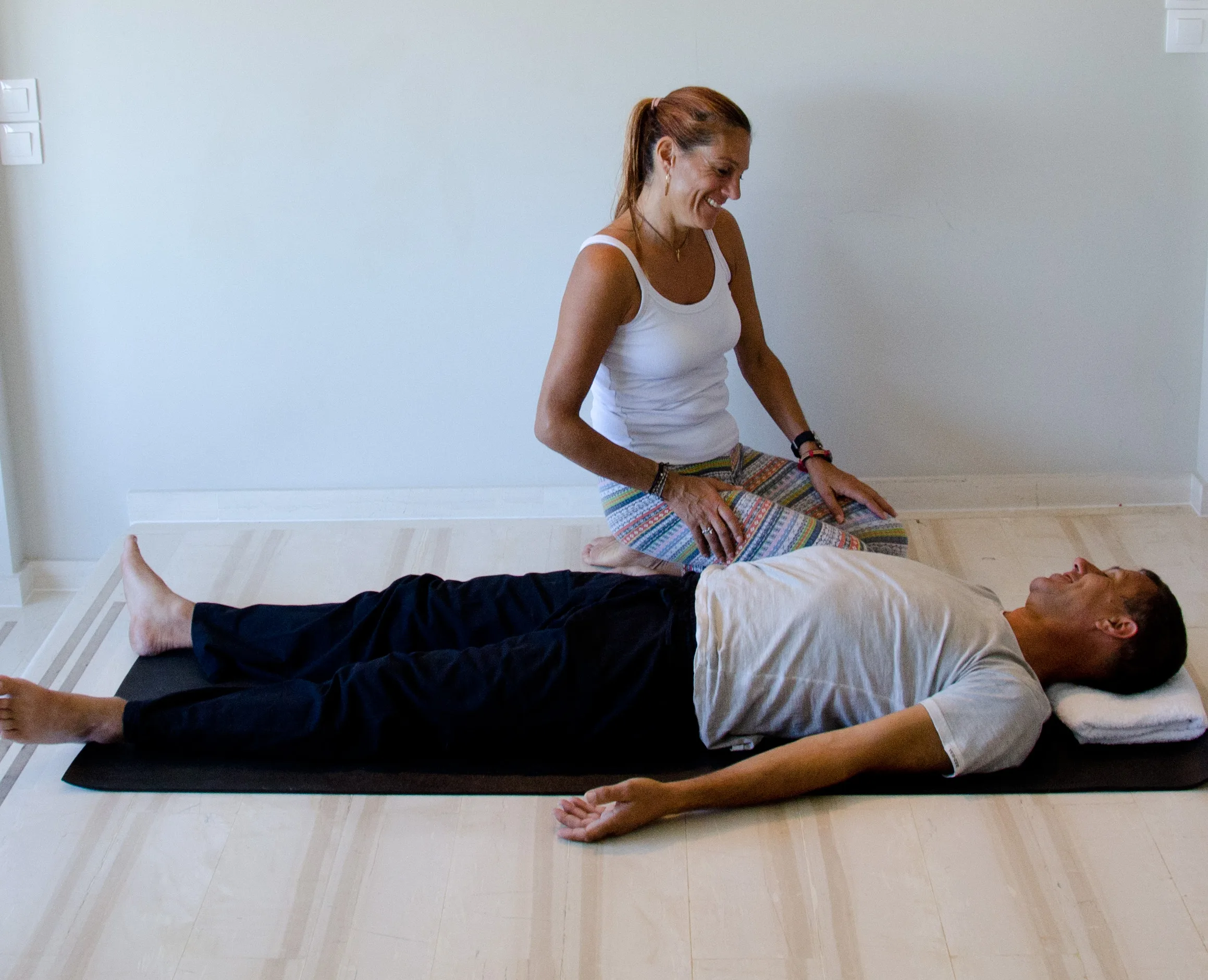
How yoga therapy takes place
1. 20-30 minute interview, where the needs, symptoms and their effects, energy levels, and lifestyle are explored.
2. Breathing, Postural, and Movement Assessments, where the breathing pattern, the range of motion, the ease of movement, and the specific parts that are in pain or discomfort are assessed.
3. Co-development of a 15-30-minute personalised home practice that considers all the above information and addresses the specific needs of the individual.
The home practice is provided in a practice sheet and/or with recorded elements.
Yoga Therapy sessions last 90 minutes or 60 minutes in the case of fatigue and take place weekly or bi-weekly, ideally for 8-12 weeks, and the practices are progressed based on the individual’s feedback.
How Yoga Therapy works
- The therapeutic relationship between the yoga therapist and the patient, the bond that is built with being heard, feeling safe, and trust– predicts engagement and outcomes.
- Yoga (with gentle range-of-motion movements and mindful/diaphragmatic breathing) activates the parasympathetic pathways and downregulates the stress-response axis (the hypothalamic-pituitary-adrenal, HPA axis). As a result, reduces cortisol, modulates inflammatory cytokines, and increases endogenous pain-inhibitory mechanisms, thereby decreasing perceived pain. In addition, reduces stiffness, enhances musculoskeletal flexibility, and improves venous and lymphatic return (Chen, 2024).
- Slow and deep/diaphragmatic breathing distracts from the pain, focuses the mind, and balances the nervous system by activating the parasympathetic nervous system through the stimulation of the vagus nerve.
- Yoga, breathing & meditation are changing brain structures such as the right amygdala, which is related to reactivity and negative emotions (Gotink et al., 2018).
What patients gain from yoga therapy
- Awareness, safety, empowerment, and motivation for the lifestyle changes they need.
- Better breathing patterns through easy-to-practice breathing techniques.
- A restorative reclining posture that facilitates relaxation and deeper breathing effortlessly, ideal for fatigue and pain.
- Easy and safe-to-do movements.
- Recorded personalised guided relaxation or meditation based on individual goals and needs.
What Cancer patients can gain from yoga and yoga therapy
Slow and deep breathing and recorded guided relaxationstarting before the operation have shown promising effects on post-operation distress (Kovacik and Kovacik, 2011).
Slow and deep breathing, movements, and guided relaxationhave shown positive effects on post-operative pain and lymphedema (Freguia et al., 2024).
Slow breathing (Wang et al., 2023) and gentle movements of the affected areas have significant results on muscle pain (Peppone et al., 2015) and on chemotherapy-induced peripheral neuropathy (Bao et al., 2020), as well as ). as well as in sleep disturbances (Zhu et al., 2023).
Guided imagery (GI) & progressive muscle relaxation (PMR) (Charalambous et al., 2016) have significant results in a cluster of symptoms such as pain, fatigue, nausea, vomiting and retching, anxiety and depression in patients receiving chemotherapy (Charalambous et al., 2016). Yoga Therapy (consisting of movements and breathing) has also shown significant results in fatigue, depression, and anxiety, even 6 months after the end the intervention (Lundt et al., 2019).
Yoga and yoga therapy, the personalization of yoga, and the daily practice of it make a change in symptoms and quality of life. More research is needed to show what yoga therapists see and what cancer patients experience.
References
- Bao, T., Zhi, I., Baser, R., Hooper, M., Chen, C., Piulson, L., Li, Q. S., Galantino, M. L., Blinder, V., Robson, M., Seidman, A., Panageas, K. S., & Mao, J. J. (2020). Yoga for Chemotherapy-Induced Peripheral Neuropathy and Fall Risk: A Randomized Controlled Trial. JNCI cancer spectrum, 4(6), pkaa048. https://doi.org/10.1093/jncics/pkaa048
- Bower, J. E., Lacchetti, C., Alici, Y., Barton, D. L., Bruner, D., Canin, B. E., Escalante, C. P., Ganz, P. A., Garland, S. N., Gupta, S., Jim, H., Ligibel, J. A., Loh, K. P., Peppone, L., Tripathy, D., Yennu, S., Zick, S., & Mustian, K. (2024). Management of Fatigue in Adult Survivors of Cancer: ASCO-Society for Integrative Oncology Guideline Update. Journal of clinical oncology: official journal of the American Society of Clinical Oncology, 42(20), 2456–2487. https://doi.org/10.1200/JCO.24.00541
- Carlson, L. E., Ismaila, N., Addington, E. L., Asher, G. N., Atreya, C., Balneaves, L. G., Bradt, J., Fuller-Shavel, N., Goodman, J., Hoffman, C. J., Huston, A., Mehta, A., Paller, C. J., Richardson, K., Seely, D., Siwik, C. J., Temel, J. S., & Rowland, J. H. (2023). Integrative Oncology Care of Symptoms of Anxiety and Depression in Adults With Cancer: Society for Integrative Oncology-ASCO Guideline. Journal of clinical oncology: official journal of the American Society of Clinical Oncology, 41(28), 4562–4591. https://doi.org/10.1200/JCO.23.00857
- Chen Q. (2024). Neurobiological and anti-aging benefits of yoga: A comprehensive review of recent advances in non-pharmacological therapy. Experimental gerontology, 196, 112550. https://doi.org/10.1016/j.exger.2024.112550
- Freguia, S., Platano, D., Donati, D., Giorgi, F., & Tedeschi, R. (2024). Closing the Gaps: An Integrative Review of Yoga’s Benefits for Lymphedema in Breast Cancer Survivors. Life (Basel, Switzerland), 14(8), 999. https://doi.org/10.3390/life14080999
- Gotink, R., Vernooij, M., Ikram, A., Niessen, W., Krestin, G., Hofman, A., Tiemeier, H., & Hunink, M. (2018). Meditation and yoga practice are associated with smaller right amygdala volume: the Rotterdam study. BRAIN IMAGING AND BEHAVIOR (print), 12(6), 1631-1639. https://doi.org/10.1007/s11682-018-9826-z
- Kovačič, T., & Kovačič, M. (2011). Impact of relaxation training according to Yoga In Daily Life® system on perceived stress after breast cancer surgery. Integrative cancer therapies, 10(1), 16–26. https://doi.org/10.1177/1534735410387418
- Lundt, A., & Jentschke, E. (2019). Long-Term Changes of Symptoms of Anxiety, Depression, and Fatigue in Cancer Patients 6 Months After the End of Yoga Therapy. Integrative cancer therapies, 18, 1534735418822096. https://doi.org/10.1177/1534735418822096
- Mao, J. J., Ismaila, N., Bao, T., Barton, D., Ben-Arye, E., Garland, E. L., Greenlee, H., Leblanc, T., Lee, R. T., Lopez, A. M., Loprinzi, C., Lyman, G. H., MacLeod, J., Master, V. A., Ramchandran, K., Wagner, L. I., Walker, E. M., Bruner, D. W., Witt, C. M., & Bruera, E. (2022). Integrative Medicine for Pain Management in Oncology: Society for Integrative Oncology-ASCO Guideline. Journal of clinical oncology: official journal of the American Society of Clinical Oncology, 40(34), 3998–4024. https://doi.org/10.1200/JCO.22.01357