Global Yoga Therapy Day
INTEGRATION OF YOGA THERAPY
SUMMARY – INTRODUCTION
Since the topic of Global Yoga Therapy Day 2026 is the integration of Yoga Therapy, I will start with the definitions of yoga therapy and integration, continue with the reciprocity of integration, I will give examples of integration and I will conclude with specific ways to integrate yoga therapy at the individual level, in multidisciplinary teams/groups and at the society level.
DEFINITIONS
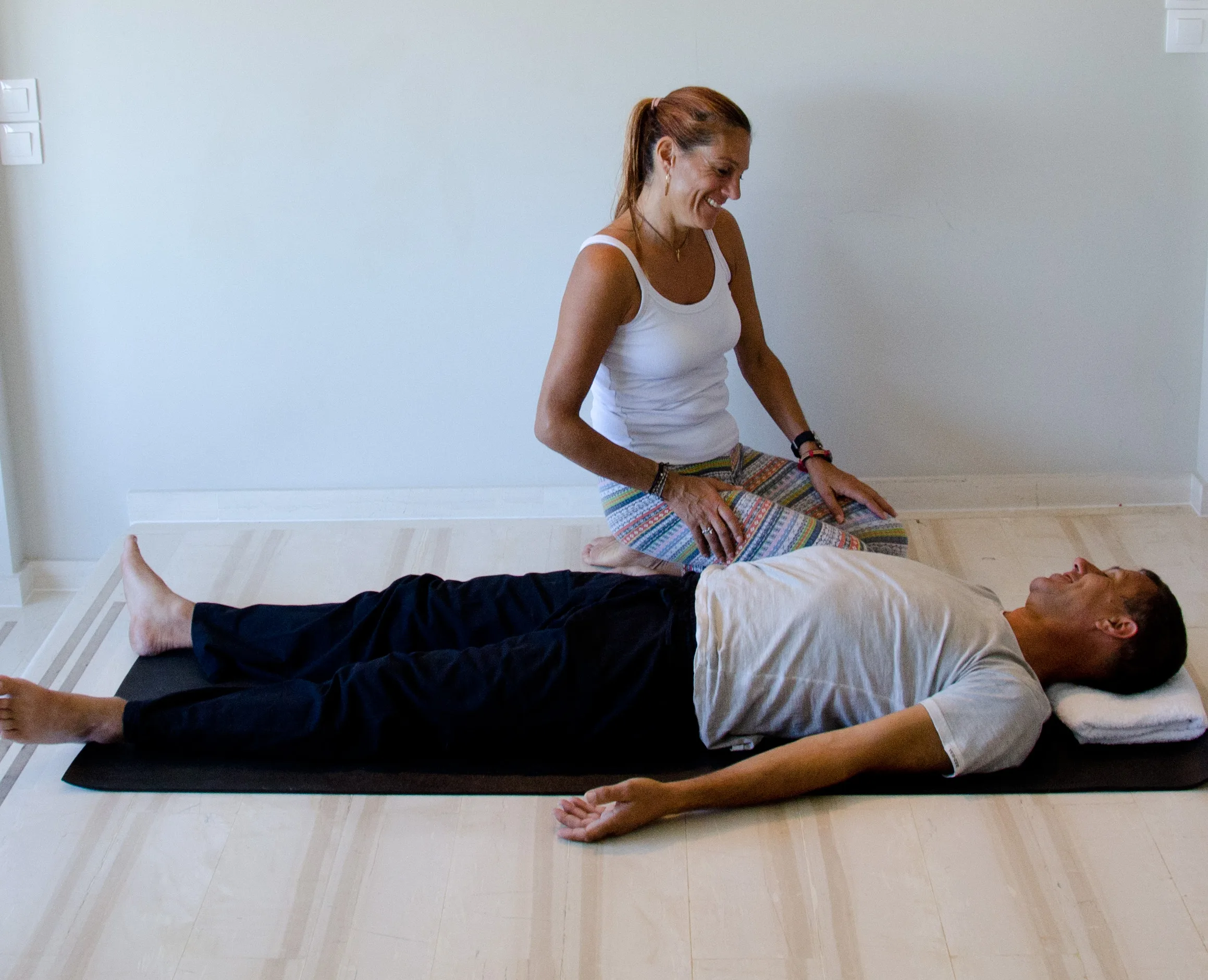
According to IAYT, Yoga therapy is the professional application of the principles and practices of yoga to promote health and well-being within a therapeutic relationship that includes personalized assessment, goal setting, lifestyle management, and yoga practices for individuals or small groups.
Yoga therapy is the process of empowering individuals to progress toward improved health and well-being through the application of the teachings and practices of Yoga.
Yoga therapy entails the application and the adaptation of Yoga techniques and practices to the individuals’ needs, aspirations, lifestyle and energy level,
focuses on the self-management of mental and physical health challenges and enhances wellbeing and quality of life.
Yoga Therapy is a personal, holistic, integrative approach, ideal for most multifactorial conditions affecting mind and body.
Integration, according to the Cambridge Dictionary, is defined as joining a group or combining things. It means the action or process of successfully joining or mixing with a different group of people or combining two or more things in an effective way.
Integration is also found as incorporation of equals into society or an organization of individuals of different groups.
And coordination of mental processes into a person or with the environment.
After the definitions of Yoga Therapy and Integration I believe it is an opportunity to explain how YOGA THERAPY IS INTEGRATIVE PER SE/BY ITSELF
Yoga Therapy is integrative by itself since it takes into account the panca maya kosha or the quite similar biopsychosocial model. In the yoga world, we know the pancamaya kosha entails the annamaya kosha (the body/the structure), the pranamaya kosha (the physiology/energy level/digestion/ elimination/menstruation/sleeping patterns), the manomaya kosha (the way people think), the vijnamaya kosha (the access to inner wisdom and intuition) and the anandamaya kosha (the ability to feel contentment/ peace/bliss, at one with something bigger).
As we also know the biopsychosocial approach takes into account the biology/physiology, the psychology/mental wellbeing and the social/environmental context of the individual such as the family status, the professional and financial condition, whether they belong to a minority or marginalized population, whether they live in a war zone or in an affluent suburb, etc.
As we can understand, yoga therapy is integrative, since it takes into account the needs of the individuals at the different levels of their being/ the koshas as well as the social and environmental context that substantially affect the individual at all koshas.
Yoga Therapy being integrative is personalized, which means by taking into account the pancamaya kosha and the social/environmental context, through the intake and the breathing/postural/movement assessments we have the ability to apply yoga individually, to co-design specific practices, to personalize the practices, to modify the practices to individuals, to group needs, to doctors’ priorities, to associations, to societies.
- EXAMPLES OF INTEGRATION
I would like to give an example of integration at the individual level.
Having studied yoga therapy intensively for over 5 years, I then studied physiotherapy with the eyes of a yoga therapist and yoga therapy educator. Whilst I was doing my 6 months practice as a physiotherapist with people who had traumatic brain injuries and strokes at a rehabilitation center, I was integrating breathing, vyana vayu and focusing the mind practices. To people with Parkinson I gave warrior I plus chanting, and to people with scoliosis tadasana, parighasana and ardha chadrasana.
Also conducting my thesis for my master’s on Neuroscience and Psychology, I integrate yoga therapy by investigating and measuring the effect of breathing during life threatening diagnosis, such as cancer.
I would like to give a couple of examples of integration from our training.
In our training we have students/yoga teachers who really want to learn yoga therapy, from all over the world bringing in different contexts and different backgrounds.
Our sangha, our students, yoga teachers and quite often health professionals such as physiotherapists, psychotherapists, come from Canada to New Zealand, from Ireland to Namibia, from the UK to Russia, from the Unites States to Japan, from Lebanon and Palestine to Israel integrating and sharing what they learn to their societies.
Another example is the training per se.
In the training we integrate yoga philosophy from Patanjalis sutras, Vedanta and samkya, Ayurveda, different yoga lineages such as Iyengar yoga and Viniyoga of Desikachar, yoga nidra from different schools and gurus, different meditations such as breathing, mindfulness, chakra, vipassana, transcendental meditation, with evidence based knowledge from robust research articles investigating the effect of mind and body interventions, of yoga and yoga therapy interventions but also what other sciences such as physiotherapy, psychology, neuroscience, medicine and nutrition do for the physical and mental challenges individuals face as well as the effect of context on the individuals.
In addition, we share in the training what other professionals may lack in order to integrate yoga therapy covering their needs.
For example, I often find physiotherapists may lack the variety of movements we have in yoga and the ability to modify the practices as we do in yoga therapy, they may not know how to integrate breathing in the rehabilitation or how to conduct a motivational interview in order to motivate their clients to do the practice and be engaged in the change they are looking for.
On the other hand, I often find psychotherapists may lack the ability to relax the mind through the body, the so called bottom up approaches.
We integrate all these elements for our students, so they can be knowledgeable, evidence based and to integrate yoga therapy in their societies by giving yoga therapy effectively in 1-2-1 and in a group level.
- INTEGRATION NEEDS TO BE RECIPROCAL
The reciprocity of integration refers to a mutual exchange. In order for the integration to be honest and effective not only should members be considered equals but the members should know each other’s needs.
In simple words, we need to know the needs of individuals, the health professionals, the different lifestyles and professions, the societies, the associations in order to integrate yoga and yoga therapy to the individuals, medicine, and societies.
In addition to knowing their needs we need to know and use their language and not our language, Sanskrit, and yoga terms.
And we need to be evidence based, meaning the yoga interventions, the practices, the yoga tools have been investigated/tested in research trials, published in research articles. Which is happening more and more in the last 20 years.
On top of that, we need to know very well how yoga and yoga therapy can address and cover these needs.
I will give an example:
We all know that yoga is good for cancer patients but we need to know the cancer patient’s needs, the effect of the diagnosis, such as identity crisis, anxiety, insomnia,
We need to know the effects of the treatments such as fibrosis/tightness or even lymphedema after an operation, brain fog, pain and aches, nausea after chemotherapy and the need for a peaceful transition in case things don’t go well.
At the same time we need to know how to support during the diagnosis by building a therapeutic relation, and by breathing practices and simple meditations; how to support with gentle movements addressing the areas affected by the treatments and gradually increase the range of motion and the intensity of the practice, how to focus mind and enhance neurogenesis for the brain fog that lasts about 2 years after the start of the treatments, how to breathe during nausea and how to relax in restoratives and stretch to release the fascia enhancing the lymph circulation and the function of the immune system but also the tension from the body and mind.
So, to integrate yoga therapy to cancer patients at individual or group levels we need to know their needs.
I will give another example: I am often invited to the International Congress of Integrative Oncology. I was in a panel presenting interventions for cancer rehabilitation and the integrative oncologists were asking us what they can do to support their patients the moment they announce a diagnosis or a prognosis. This is their need.
Knowing how breathing can affect the nervous system when a perceived threat is alarming/activating the nervous system, we know that a simple breathing practice such as pursed lips exhalation could be offered with promising effects.
Last but not least, I would like to say a few things about
- HOW TO INTEGRATE YOGA THERAPY AT AN INDIVIDUAL LEVEL AND IN A MULTIDISCIPLINARY TEAM
We can integrate yoga therapy by connections such as this very beautiful virtual gathering, by attending conferences, by continuous professional development through high-quality studies, by memberships to associations, by reading journals, by critically reviewing research articles, by giving yoga therapy to health professionals, journalists, opinion leaders and gate keepers, by collaborating well in groups. EXPAND ON EACH POINT IF HAVE TIME
Last WORDS
I hope I have managed to convey how integrative yoga therapy is, how integrative a yoga therapist and yoga therapy training can be, why integration must be reciprocal and how to integrate yoga therapy.
Thank you for the invitation and for the space.
In case you want to connect, please visit the website of www. yoga therapy Greece.com