How a Yoga Therapy takes place

Yoga classes are generally ‘one size fits all’, since the same practices are given to everybody, while the yoga teacher is unaware of the student’s relevant health information.

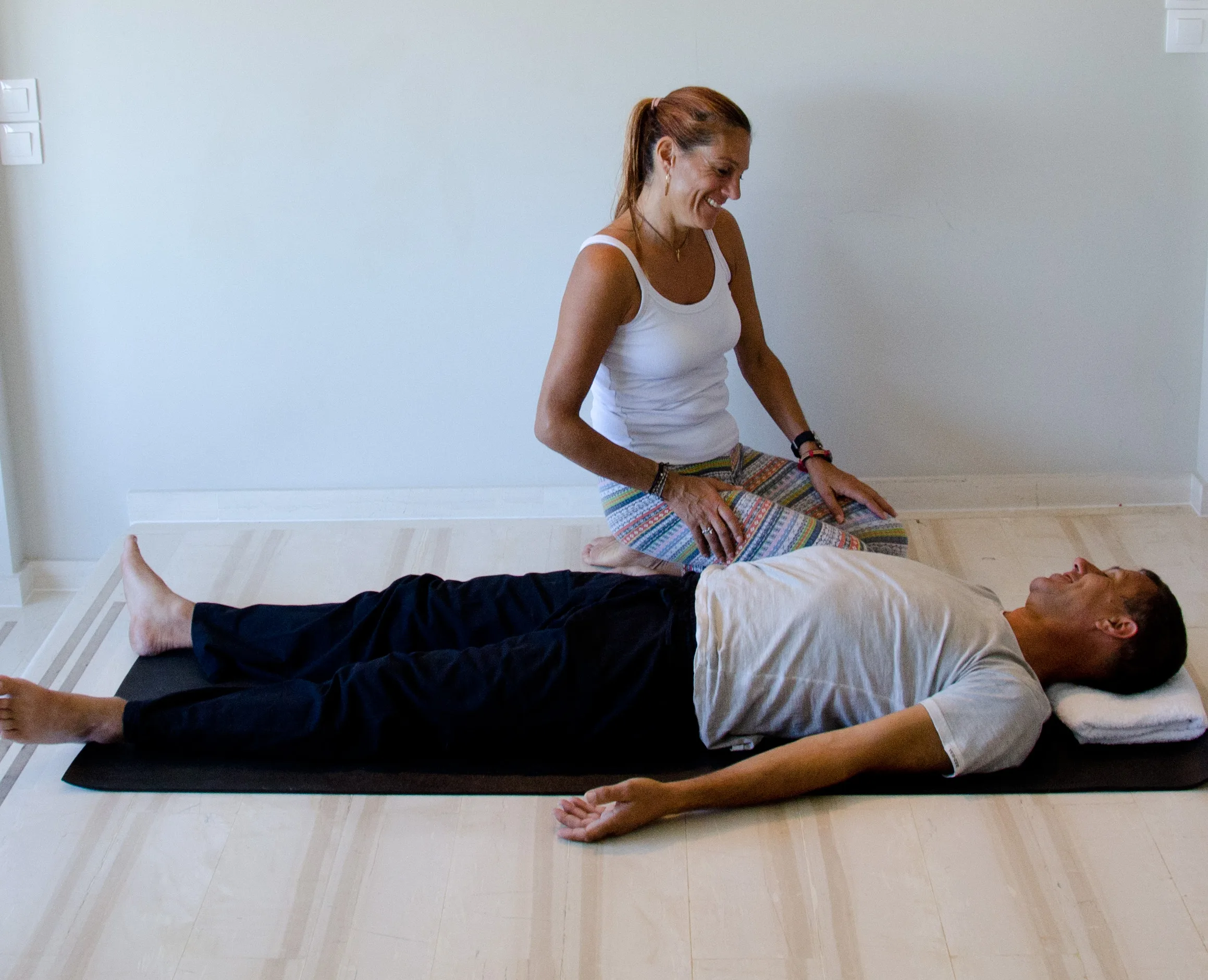
On the other hand, Yoga Therapy starts with the completion of a confidential Health Information Form and continues with the personal intake, postural movement and breathing assessments. Based on these and the feedback a personal practice is developed that addresses the goals and the limitations of the patient.

The personal and individualized short and simple yoga practice usually includes movements/exercises/asanas, breathing awareness, a simple breathing practice, guided relaxation or meditation and healthy lifestyle tips. The practice is given written and drawn with simple stick figures with the date and the name of the individual.

Through the movements we mostly address the structure either releasing tension or strengthening the area affected.

Through simple breathing practices, we address the state of the nervous system, either relaxing it by elongating the exhalation or lifting the energy levels by enhancing the inhalation and lifting the spirit.

The personalized short, guided relaxation based on the intake, the needs of the individual and the state of their mind & nervous system further supports patients’ needs by establishing a more balanced state of mind. 

The yoga therapy sessions ideally last 90 minutes, although they can last only 60 minutes, except for the first one that needs to be 90 minutes due to the assessments. The second session usually takes place after a week practicing the personal yoga therapy sequence.

In the second session, based on the individual’s feedback we further develop the practice either modifying it or making it more complicated.

The third session usually takes place 2 weeks after the second one and the fourth session 3 or 4 weeks after the third one.

So, in total the 4 sessions take place within 2 months. In this way, the person gives the opportunity for the practice to show its results but also individuals get used to doing a personal 20–30-minute mind and body practice that works for them. It is their practice, the practice that was developed based on their feedback, on their body, on their energy levels and on their lifestyle.

Yoga Therapy is not only given in 1-2-1 but also in groups as in clinical studies where there are inclusions and exclusions criteria.

Yoga Therapy is given in groups of about 10 people with the same condition or symptoms such as stress and anxiety, insomnia, osteoporosis, chronic fatigue, fibromyalgia, hypertension, multiple sclerosis or breast cancer where people are at the same treatment stage.

They usually take place on a weekly basis for 1 hour and for 8 weeks in total. They also start with the completion of the confidential information form and an hour session where the intake and the postural, movement and breathing assessments take place.

The assessments show whether it is safe and beneficial for the individuals to join but also the need for personal modification of the group practice and of the small and daily home practice. The small and personalized home practice is sent by email every week and is a fraction of the group practice. The 1-hour group practice is gradually modified every 2 weeks getting slightly more mentally or physically elaborate and intensive, while the home practice having started quite short and simple is getting longer and more effective. At the end of the 8 weeks, a specific to the condition feedback form evaluating the effect of the practice is completed by every participant.


More News & Articles

News
13.09.2026

NCIO 2026 Conference – Personalised Yoga for Cancer Pain & Symptoms

Yoga Therapy – Personalised Yoga for Cancer Pain & Symptoms By Evi Dimitriadou C-IAYT Yoga Therapist, Registered Physiotherapist in the UK, PG in Neuroscience & Psychology at King’s College, London. Founder of Yoga Therapy Greece Clinic and School & Yoga Therapy Educator. This is a short presentation at the NCIO in Oxford University on 19th […]

Articles
04.09.2026

Mental Health, Sustainable Development and Yoga Therapy

An article on Mental Health, Sustainable Development and Yoga Therapy, by Evi Dimitriadou published by the International Assosication of Yoga Therapists (IAYT) in the Yoga Therapy Day Journal, Summer 2026 issue.  It describes the relationship between mental health to social and environmental factors, the Sustainable Development Goals agreed by the UN that determine mental health, and […]

θεραπευτικη γιογκα αθηνα Articles
04.09.2026

CALL FOR PEACE

Call for Peace, condemning violenceAs yoga practitioners, yoga teachers, yoga therapists, yoga and yoga therapyassociations, why are we not questioning strongly our lack of contribution for peacecondemning the ongoing violence and destruction that has been happening for years?Ahimsa (non-violence in sanskrit), the first yama, one of most the fundamentalprinciples of yoga by Patanjali. It is […]

Articles
04.09.2026

Global Yoga Therapy Day

INTEGRATION OF YOGA THERAPY  SUMMARY – INTRODUCTION Since the topic of Global Yoga Therapy Day 2026 is the integration of Yoga Therapy, I will start with the definitions of yoga therapy and integration, continue with the reciprocity of integration, I will give examples of integration and I will conclude with specific ways to integrate yoga […]

Articles
17.05.2025

Yoga & Yoga Therapy for every treatment of Cancer

A summary of Evi’s Dimitriadou presentation the British Society of Integrative Oncology on the role of Yoga Therapy to Cancer Patients and survivors. Cancer and Cancer treatment-related side effectsCancer patients and survivors not only experience the disease, but they also sufferfrom cancer treatments’ side effects that may last for years after the completion ofthe treatments. […]

Mental health Articles
07.04.2025

Mental health and well-being living in Cities

Mental health and well-being living in CitiesWell-being is referred to feeling content, function well, have positive relationships, some control over one’s life and a sense of purpose,  while mental health is defined by the World Health Organization as ‘a state of well-being in which the individual realizes his or her own abilities, can cope with […]

Articles
10.06.2024

Children Mental Health – Aggression & Yoga Therapy

Aggression- Conduct Disorder and Interventions by Evi Dimitriadou for Master’s in Neuroscience and Psychology of Mental Health, King’s College, London, UK. Mental Health in Children & Adolescents Children are struggling to understand what is happening in their mind and maybe in their life as well as in their society where they live. They struggle to […]

Articles
28.05.2024

Yoga Therapy for Dementia

Dementia Dementia is a syndrome, usually chronic or progressive, that leads to deterioration in cognitive function (i.e., the ability to process thoughts, loss of autobiographic and overall memory) beyond what might be expected from the usual consequences of aging. Alzheimer’s disease is the most common type of dementia, which is an umbrella term for a […]

Articles
25.05.2024

Mindfulness Programs and its effect

Mindfulness means ‘the awareness that arises from paying attention, on purpose, in the present moment and non-judgmentally’. MBSR is an 8-week program practicing mindfulness daily through 45 minutes body scan (similar to yoga nidra a guided meditation on a lying position reconnecting practitioners with their breath and body), seated meditation, mindful and gentle yoga (slow […]

Articles
06.05.2024

Yoga Therapy Choice and Change

In Yoga Therapy, we help people see that they always have a choice. We may not be able to change what has happened or what is happening, but we can change  the way we relate to it and as a result its effectson mind, body and soul. To change something, we need to be aware […]